(Magazine Profile): Dr. Peter Galie
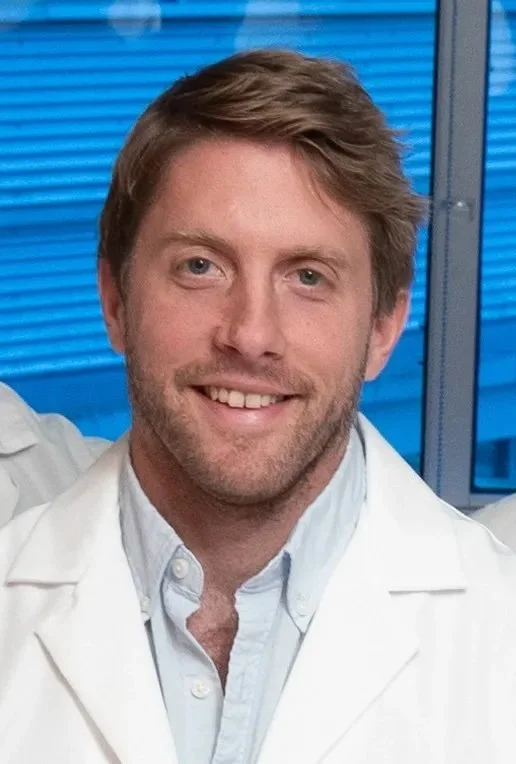
Dr. Peter A. Galie, Ph.D., Associate Dean of Research and Graduate Studies and Professor of Biomedical Engineering at Rowan University
The pipette hovers over a tiny petri dish, and Dr. Peter Galie doesn’t blink. Around him, the lab hums with the soft whir of fluorescent lights and the gentle sounds of incubators. He adjusts the instrument with deliberate care, as if coaxing a secret from the cells themselves.
“This might look simple,” he says, his voice calm, “but it’s keeping cells alive outside the body. That’s all that matters.” The words are matter-of-fact, but there’s something magnetic about the focus behind them, a quiet intensity that draws graduate students and colleagues alike to watch him work.
He’s an unassuming man with sandy blond hair and a goofy grin. The best way to describe his personal style is, by way of a student evaluation, ‘dresses as though his wife dresses him.’ Though he dresses like his own man, very professional yet business casual. He sports light blue jeans, a plaid button-down shirt, and what appears to be a soft navy blue fleece vest. On his left hand, a silver band gleams from the sunlight. He wears it with matrimonial pride, as a symbol of his undeniable love for his wife and four children.
It’s that intensity, paired with humility, that makes Dr. Galie a unique figure in biomedical engineering. His work in regenerative medicine, creating scaffolds that damaged tissue heals, has earned him national recognition and various published research that shape the field.
“Even with the awards. I keep thinking there’s more to do.” In a world that is obsessed with accolades, Dr. Galie’s restless curiosity is what defines him.
On a crisp Tuesday morning, he moves through his lab like a conductor directing an orchestra. Each instrument, the centrifuge, microscopes, and the incubators, serves a role. Like any conductor, he ensures they are fine-tuned. A graduate student leans in, clipboard ready, eyes alert for instructions. He doesn’t rush. His hands move with precision, guiding cells into fragile yet vital gels.
“Cells need something to cling to,” He explains to the student, pointing to the scaffold. “If it’s too stiff, they can’t grow. If it’s too soft, they collapse. We’re building a tiny bridge for life itself.”
The lab is alive with quiet energy. Students move between the bays, jotting down notes and adjusting instruments. Even in these routine motions, there’s a rhythm tethered to a shared sense that each small decision matters. Dr. Galie checks an incubator, tweaks a mixture, and nods approvingly at a student’s cautious work. Mistakes are inevitable, he reminds them, but they are part of the learning process.
“We learn as much from failure as success,” he says, with a soft smile. Peter grew up in the suburban town of Cherry Hill. Born into a family of engineers, Peter grew up tinkering and fixing his toy cars with toy hammers, screwdrivers, and wrenches. He’s the second youngest child in a family of six that includes his older sisters, Gina, Jess, and his younger sister, Terry. His sister Jessica Morell remembers a boy whose curiosity seemed endless.
“He wanted to understand everything,” she says. “And he still does.” Ultimately, that drive carried him through college at Princeton University, where he ran in many events. Though it wasn’t until he reached graduate school at Rensselaer Polytechnic Institute in Troy, New York, that his fascination with the mechanics of life found a new outlet, tissue engineering. Today, Dr. Galie is a respected researcher and serves as the associate dean of research and graduate studies at Rowan University’s Henry M. Rowan College of Engineering’s Department of Biomedical Engineering. There, he guides his students who are following the same path he once walked.
His journey hasn’t solely been technical. Galie often reflects on the people who shaped him, the mentors who demanded understanding over rote memorization, colleagues who have challenged his ideas, as well as the students who remind him why patience and clarity matter.
“I don’t just want students to follow instructions,” he says. “I want them to understand the why. That’s where the learning happens.” One of his current undergraduate students, Adam Boberick, 21, is a biomedical engineering major assisting Dr. Galie with research. Boberick currently looks into drag-reducing polymer development and validation within the lab.
“He’s very approachable, knowledgeable about his field, and professional,” Boberick says. He first met Galie after his freshman year seminar, a requirement for students in the biomedical engineering department. It was in that class that Boberick reached out to Galie after he let students know he was looking for undergraduate assistant researchers. Since reaching out to him, Boberick ditched the idea of working through various professors and formed a four-year partnership with Dr. Galie.
Outside the laboratory, Galie’s curiosity never wanes, extending into board meetings. He listens more than he speaks, asking questions that reveal the bigger picture without overwhelming the technical details. When it comes to complex scientific terminology, he’s able to translate it into an understandable language that’s accessible to all. At a meeting, discussing neural tissue scaffolds, he paused to exemplify how subtle changes in gel stiffness affect a cell’s overall survival.
“It’s not just about engineering,” he says. “It’s about lives.”
Even in high-pressure environments, his human side remains visible. He jokes with students about past mishaps, ice too cold, and samples lost to humans. He tampers with the lab’s tension with humor.
“Scinect can be brutal,” he says. “But mistakes are just lessons you didn’t know you were learning.” That combination of humor, humility, and focus makes him magnetic, drawing people into both his work and his mentorship.
Colleagues and family also note his humbleness despite the recognition. His accolades are secondary; what matters to Galie is the process. “I see the work we do and think, this could be bigger, better,” he says.
“Recognition is flattering, but it’s not what drives me.” That philosophy resonates with students who are not learning techniques alone but rather a mindset of persistence, patience, and relentless curiosity.
In the lab, he demonstrates concepts with analogies that resonate with beginners and experts alike. He kneels to show an intern the microscopic scaffolds guiding cells.
“Think of it like a tiny bridge,” he says. “Cells need something to cling to and move along. If the bridge is too weak or too stiff, it can’t survive. That’s why we spend so much time getting it right.” His explanations are grounded, clear, and human, an invitation to understand rather than a lecture to endure.
Even with years of experience, Galie approaches each day as if it were a work in progress. He adjusts gels, monitors cell growth, and encourages students to ask questions. Every small success is a step forward, every failure an opportunity to learn. The process itself, he insists, is what matters.
“We’re trying to do something meaningful,” he says. “Even if it doesn’t feel complete yet, every experiment is part of that story.”
At the end of the day, the lab is a quiet, humming ecosystem of life, curiosity, and potential. Gels set in warm trays, instruments buzz steadily, and students pack up their notes. Galie moves through the room, observing, adjusting, silently acknowledging each moment. For all the technical details, what stands out is his humanity, patience, humor, and an unshakable drive to understand and improve.
“I haven’t done enough,” he says, repeating what has become a quiet mantra.
