(Opinion) Love Is Embarrassing
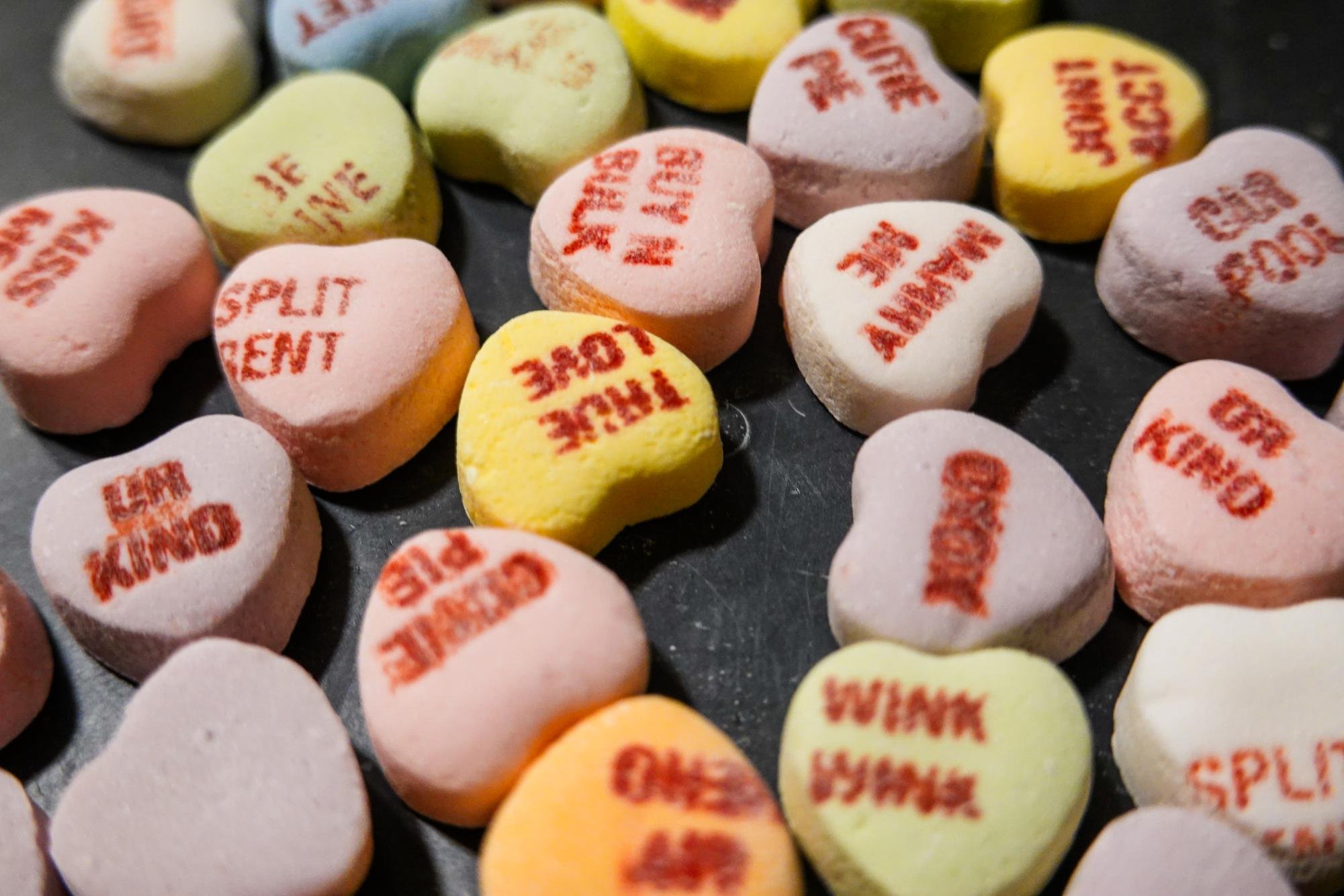
Brach’s Candy Conversation Hearts. (Photography: by: Michael Bautista)
Love has always had a branding issue.
For something so universal, love has the uncanny ability to make otherwise competent adults behave like they’ve misplaced their frontal lobes.
And you know what? We don’t talk about that part enough. For centuries, it’s been marketed to us as something so flawless. The ambient lighting, sweeping string of classical violins, and next thing you know, someone is getting down on one knee and pulling out a bouquet of roses, knowing exactly what to say.
Nothing makes me sicker or roll my eyes more than the picture-perfect proclamations of romance every Valentine’s Day. But anyone who has actually experienced love in real time knows the truth. Love is embarrassing as hell.
I’m not talking about occasional or isolated incidents at all. Love, by design, asks of us a tall order: to abandon the calculated versions of ourselves we’ve designed and walk directly into a blazing fire of uncertainty.
And yet, like the people who claim they enjoy hot yoga or pilates, we keep coming back. It’s stupid, right? But consider the most humiliating sentence in the English language, “I like you.”
Even thinking about it gives me war flashbacks. It’s short and simple, but my goodness, it’s terrifying to say aloud. But why is that? Because in the moment you’ve uttered those words, you’ve just pulled the most dangerous trigger. Believe it or not, the moment you admit to someone you like them, the power dynamic shifts. And like a fool, you’ve supplied that person with deadly ammunition. Handing them a small but meaningful piece of emotional leverage.
While they stand there deciding what to do with it, you’re forced to be fully present, perhaps with a flurry of questions. Will they like me back? smile at me? Or will they just stand there and look at me like I’ve delivered the news that their dog passed away?
No matter what anyone tells you, there’s no feasible way to deliver that confession without feeling at least slightly like you’ve stepped onto thin ice. And that is before we can get into the grandiose gestures.
Somewhere along the way, we’ve accepted the concept that love should occasionally require a theatrical risk. Just watch any Disney Princess movie. Flynn Rider called for Rapunzel to let down her hair, Prince Charming ran after Cinderella after she’d left the ball, and Kristoff put together a whole musical number just to propose to Anna.
But not too long ago, your parents also might have done the most cringeworthy things all for the sake of love, like tossing pebbles at the window or showing up in their high school crush's backyard with a boombox. The 1990s weren’t that long ago, but in 2026, the thought of these dramatic displays of affection has me wanting to jump into the ocean.
From a distance, these gestures sound charming. But up close, in the real world, they feel like voluntary embarrassment. Because every grand romantic move carries the same question: “What if this doesn’t land?”
Love asks people to risk being perceived, and nothing challenges the human ego like the possibility of being perceived incorrectly.
And the embarrassment doesn’t stop with over-the-top moments. It also lives in the moments we don’t think about too often, like writing a text message to someone you like and then suddenly acting like you’re editing a paper. You write, read, delete, and repeat. Removing a word here and there because now it feels like too much, or too little. What should’ve taken five seconds has suddenly turned into a full internal review process.
Love has a funny way of making otherwise decisive people stare at their own words like they’re defusing a ticking time bomb. But that’s not the most stressful part; it’s the waiting game.
Have you ever told yourself you’re fine, busy, or perhaps you swore you’re absolutely not thinking about whether they're going to text you back, call, or follow through with those plans? And yet. Somewhere in the back of your mind, your attention keeps shifting back to the same question. Did they respond?
Few experiences humble a person faster than anticipation. Don’t worry, you’re not unique to this because you have a smartphone. Your parents also probably did the same. Sitting by the landline in the family room, waiting for a phone call.
How humiliating. But perhaps the most brutal and embarrassing experience of them all is getting ready for someone who never shows. I’ll admit, I’ve actually had this happen to me numerous times, but never in a romantic regard. It’s usually been with friends.
There is something uniquely exposing about the full pre-date ritual, the outfit planning, extra time in the mirror, and cautious optimism that tonight might actually be something monumental. Suddenly, you find yourself checking the time a little too often. Then, at some point, it stops being about inconvenience and starts being about visibility. Because the embarrassing part isn’t just that the date didn’t happen.
It’s that for just a moment, all that hope was on display. If we’re being honest, love has even convinced the most rational adults to dabble in a little light superstition. The quiet bargaining, the hopeful overinterpretation of small signals, the low-level belief that maybe, just somehow, the story isn’t finished yet.
Part of the discomfort can be traced back to the stories we were raised on. For years, popular romance narratives like fairytales suggested that love would arrive with clarity. Both of you would know that this is it. The universe would even provide lighting cues, and if you’re lucky, a wind machine.
Instead, real love arrives unannounced. It’s slightly inconvenient and completely uninterested in your desire to look composed. And maybe that’s exactly the point. Love was never meant to be smooth. It was never designed to protect your dignity at all costs. Love is supposed to be a bit cringey, super messy, and humbling at times in a way that has you questioning what you did or said.
Just read any Shakespeare sonnet or play. The man built an entire literary legacy on people acting emotionally unwell in the name of love. Romeo and Juliet was not some masterclass of composure; it was a full-on theatrical decree of romance. What we label as embarrassing is, more often than not, simply evidence of humanity. Do not be afraid to embrace it in the name of love.
