(Features) New Environmental Advocacy Course Sprouts at Rowan University
Before they ever pick up a protest sign, students at Rowan University can start learning about real environmental change within the classroom.
That idea sits at the center of environmental advocacy, a course taught by Ted Howell, associate teaching professor in Rowan’s Department of Writing Arts under the Ric Edelman College of Communication, Humanities & Social Sciences, that challenges students to move beyond discussion and interaction, transforming concern into tangible impact across campus and beyond.
Originally developed more than a decade ago within Rowan’s environmental studies curriculum, the course had fallen out of rotation before Howell revived it with a new, hands-on approach. Where it once leaned on theory and case studies, it now revolves around a semester-long, student-driven project, designed to leave a lasting mark.
“I really wanted it to be practical,” said Howell. “A chance for students to do something rather than just learn about it.”
Each semester begins with exploration. Students spend the first few weeks researching issues, discussing ideas, and ultimately, choosing a cause that reflects their shared interests. That decision shapes the rest of the course, giving students both ownership and responsibility over what they create.
For Jayna Tistan, a junior studying environmental and community planning, that shift was immediate.
“When I first signed up, I was expecting to be learning about environmental advocacy, more broadly, and by the textbook,” said Tistan. “However, we focused on our campus and hands-on advocacy.”
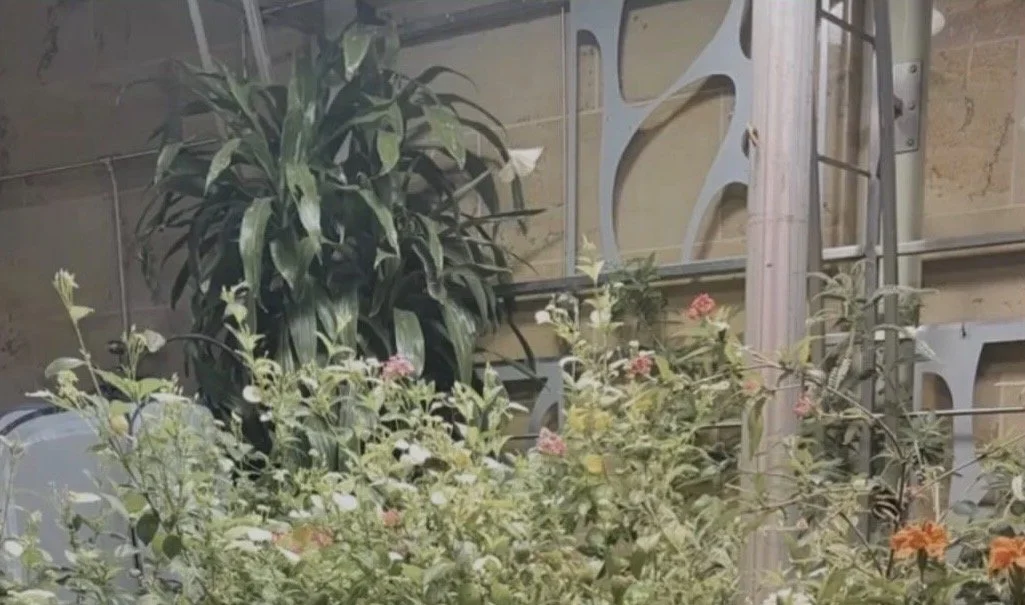
Her class chose to design and distribute zines educating peers about native plants, an approach that blended creativity with accessibility. By the time they finished tabling their work, every copy was gone.
“Students were eager to learn,” said Tistan. “By the end, we were all out of them.”
That kind of engagement is intentional. Howell said the course is designed not only to teach advocacy, but to counter the growing sense of helplessness many students feel about environmental issues.
“One of the best ways to respond to that feeling of concern and dread is by actually doing something,” said Howell.
Still, the course does not shy away from the realities of advocacy work. Students must navigate challenges, limited time, competing ideas, and the difficulty of creating meaningful change within a single semester. They are also encouraged to engage with opposing viewpoints, an exercise Howell sees as essential to effective advocacy.
That balance between action and understanding is what makes the course particularly impactful, according to Dr. Corianne Tatariw, assistant professor within the Department of Environmental Science at Rowan University.
“Environmental science and environmental advocacy or complementary topics,” said Tatariw. “Effective advocacy leverages scientific knowledge.”
She emphasized that students must learn how to translate complex scientific ideas into messages that resonate beyond academic spaces, whether with policymakers or the general public.
“A course like this will help. Students build science and translation skills to bridge the gap between knowledge and action,” said Tatariw.
For students like Tistan, that bridge has already been crossed in how they see their role in the world.
“Actually taking action makes me realize how I can continue to do this even after the course,” said Tistan. “We cannot take action without education.”
Looking ahead, Howell hopes the course’s impact will extend beyond any single semester. Success, he believes, means creating projects that remain visible efforts, future students can build on, and communities can benefit from after the class ends.
The course “Environmental Advocacy” is currently available for registration on the self-service banner, MyRowan Portal, under section number WA 01404, and the special topics course number is 40887. The class will only be offered for the fall 2026 semester, and it meets on Fridays from 9:30 a.m. to 12:15 p.m. Students interested in registering should speak with their academic advisor before enrolling.
